 Real Estate TeamLet's talk
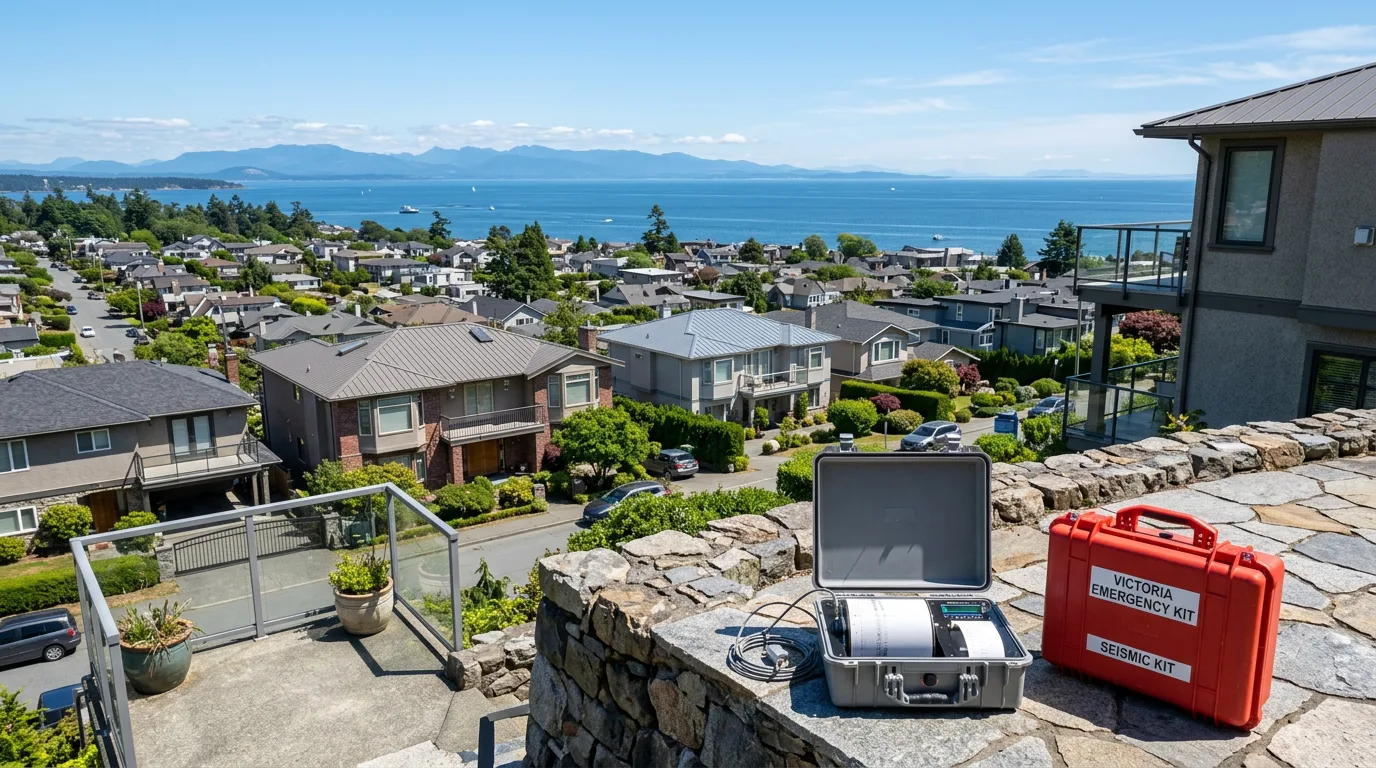
Greater Victoria sits in one of the most seismically active parts of Canada. Natural Resources Canada describes an offshore Cascadia subduction zone where the Juan de Fuca plate moves toward North America at two to five centimetres a year, with a recurrence of large megathrust earthquakes on an irregular cycle of several hundred years. Inland crustal earthquakes closer to populated areas occur more often than the megathrust events.
PreparedBC, the provincial emergency preparedness service, describes an earthquake large enough to cause structural damage as occurring about once per decade somewhere in British Columbia. Household preparedness guidance has not changed: the Drop, Cover and Hold On response during shaking, a seventy-two-hour emergency kit at home and a separate grab-and-go kit by the door are the three items the Province repeats.
A standard home insurance policy in British Columbia does not cover damage caused by an earthquake. Most Canadian home policies exclude earth movement, which includes shaking damage, landslide and sinkhole. Insurers offer earthquake coverage as a separate endorsement on the home policy. Confirm directly with your insurer what coverage you hold today and what an earthquake endorsement would add.
Earthquake endorsements in British Columbia usually carry a percentage-of-dwelling-value deductible rather than a fixed dollar amount. A ten or fifteen per cent deductible on the insured rebuild value is common in higher-risk regions, which puts the out-of-pocket amount in the tens of thousands of dollars on a typical Greater Victoria home. Ask your insurer for the exact percentage and the dollar figure it produces for your home.
What the endorsement covers varies between insurers. Common inclusions are the dwelling, attached structures, personal property and additional living expense while the home is uninhabitable. Common exclusions are land, retaining walls, swimming pools and fences. Damage caused by a subsequent fire after an earthquake is sometimes covered by the standard fire portion of the policy, and sometimes only by the earthquake endorsement. Read the wording with your broker.
Older Greater Victoria homes built before the 1970s often have an unreinforced brick chimney, post-and-pier foundations or lath-and-plaster walls. A seismic upgrade such as a foundation retrofit, bolted-down water heater or chimney removal lowers the chance of damage in an earthquake. A few insurers consider retrofits when setting a premium; ask your insurer which upgrades they recognise.
If you are buying a home, add an earthquake insurance question to your subject conditions. Confirm availability and premium with your preferred insurer before you remove conditions, because not every insurer offers the endorsement on every postal code, and a home that cannot be insured for earthquake is harder to refinance later.
The sources below were reviewed on November 25, 2026. Insurance terms vary by insurer; obtain a current quote and read the policy wording before you rely on this summary.
Sources
For current information about buying or selling in Greater Victoria, contact Dane.